
Lucio Anneo Seneca: Biography, Philosophy, and Works of the Thinker from Córdoba

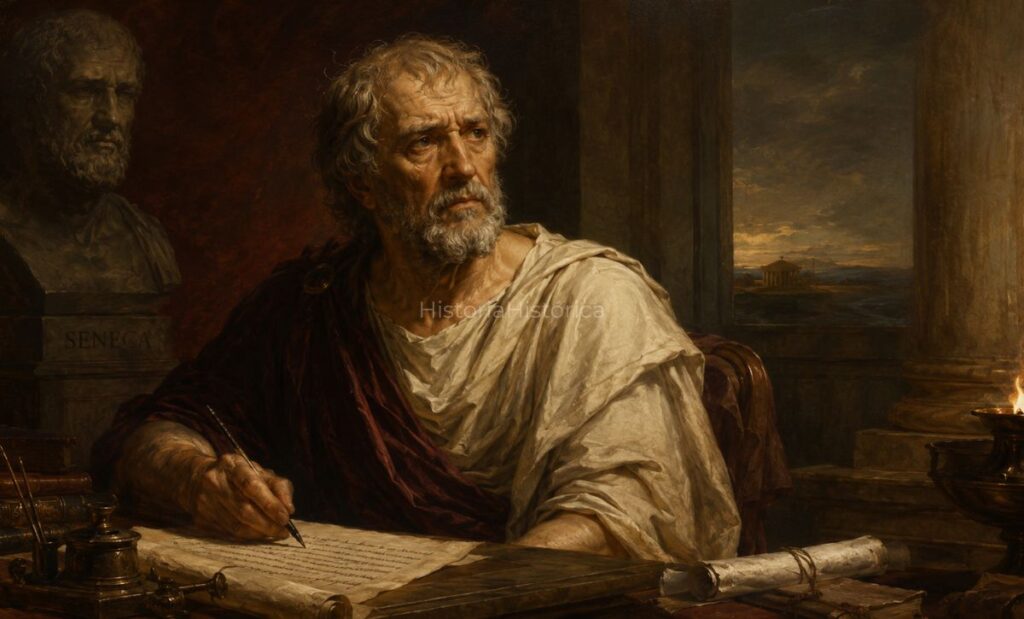
Lucius Annaeus Seneca was a Roman philosopher, statesman, orator, and writer born in Corduba (modern-day Córdoba) around 4 BC. He is the foremost representative of Latin Stoicism and served as tutor and advisor to Emperor Nero.
Who Was Seneca?
Seneca the Younger, the name by which he is distinguished from his father, Marcus Annaeus Seneca, pursued a dual career as both a public official and a philosopher. He served as quaestor, praetor, senator, and suffect consul during the reigns of Tiberius, Caligula, Claudius, and Nero.
As a writer, his legacy constitutes the most complete surviving written source on Stoic philosophy. He combined moral treatises, letters, tragedies, and works on natural science in a clear style free from excessive technical language, allowing his ideas to continue being read today well beyond academic circles.
Seneca effectively governed the Roman Empire between AD 54 and 62 alongside the prefect Sextus Afranius Burrus during the early years of Nero’s reign. This period of power came to an abrupt end: accused of participating in a conspiracy against the emperor, he was forced to take his own life in AD 65.
Where Was Seneca Born? Córdoba and Roman Hispania
The question of where Seneca was born has a clear answer: in Corduba, the capital of the Roman province of Baetica, in Roman Hispania. His family belonged to the Hispano-Roman elite at a time when the province was experiencing remarkable prosperity within the Empire.
His father, Marcus Annaeus Seneca, was an imperial procurator who became a renowned expert in rhetoric. His mother, Helvia, came from a noble family from Urgavo, in what is now the province of Jaén. The couple had three sons:
- Lucius Annaeus Seneca, the philosopher.
- Novatus, better known as Gallio, who became governor of Achaea.
- Mela, a financier and father of the poet Lucan, making him Seneca’s nephew.
The exact year of his birth is not known with certainty, although historians generally consider three possible dates: AD 1, AD 4, or AD 5. The most widely accepted date places his birth around 4 BC.
Seneca’s Biography: Childhood and Education
Relatively little is known about Seneca’s early years, and much of what we do know comes from his own writings. While still a child, he was sent to Rome, where he was raised under the protection of his aunt Marcia, his mother’s half-sister.
In the capital of the Empire, he received a comprehensive education in grammar, rhetoric, and philosophy, the standard disciplines for the education of a future senator. It was during this period that the philosopher Attalus introduced him to Stoic thought.
Marcia’s husband was appointed governor of Egypt by Emperor Tiberius, and Seneca accompanied the couple to Alexandria. That stay proved decisive for his education:
- He acquired knowledge of public administration and finance.
- He studied the geography and ethnography of Egypt and India.
- He deepened his knowledge of the natural sciences, a field in which, according to Pliny the Elder, he became particularly distinguished for his expertise in geology, meteorology, and oceanography.
- He came into contact with Eastern mystical traditions, which temporarily drew him toward Pythagoreanism and vegetarianism.
In time, he definitively embraced Stoicism, the philosophical school he would follow for the rest of his life. Seneca also suffered from fragile health from childhood onward, marked by chronic asthma that would remain with him until his death.
Political Career: Quaestor, Praetor, Senator, and Consul
In AD 31, after returning to Rome, Seneca began his cursus honorum as quaestor, despite his provincial origins and delicate health. He soon gained a reputation as one of the Senate’s most brilliant orators.
That same reputation also brought him trouble. When Caligula succeeded Tiberius in AD 37, the new emperor, according to the historian Cassius Dio, ordered Seneca’s execution out of jealousy for his oratorical talent. He was spared only because Caligula was convinced that the ailing Seneca would soon die of natural causes.
In AD 41, following Claudius’ accession to the throne, Seneca was condemned once again, this time to exile in Corsica, officially on charges of an alleged affair with Julia Livilla, Caligula’s sister. Historians suggest that the real force behind the sentence may have been Messalina, Claudius’ wife, who regarded him as a political threat.
During his eight years of exile, Seneca wrote works of philosophical consolation, including one addressed to his own mother. In AD 49, after Messalina’s downfall, Claudius’ new wife, Agrippina the Younger, secured his rehabilitation and arranged for him to be appointed praetor.
Seneca and Nero: Tutor and De Facto Ruler
In AD 51, at Agrippina’s request, Seneca was appointed tutor to the young Lucius Domitius Ahenobarbus, the future Nero. When Nero came to power in AD 54 at just seventeen years of age, Seneca became his chief political advisor alongside the military officer Sextus Afranius Burrus.
For nearly a decade, the two effectively governed the Roman Empire, although formally neither held any institutional office beyond that of senator. Emperor Trajan himself later described this period as one of the finest governments of the entire imperial era.
Among the measures promoted by Seneca and Burrus were:
- The reduction of certain indirect taxes.
- The suppression of corruption among provincial governors.
- A successful military campaign in Armenia under the command of General Corbulo, which strengthened the Empire’s eastern frontier.
- Improved legal treatment of slaves.
- The dispatch of expeditions to locate the sources of the Nile River.
Over the years, Nero gradually freed himself from the influence of his former teacher. In AD 58, the advisor Publius Suillius Rufus launched a campaign to discredit Seneca, accusing him of hypocrisy, usury, and excessive wealth—the latter accusation appearing well founded in light of the immense fortune he accumulated.
The murder of Agrippina on the orders of her own son in AD 59 marked the beginning of Seneca’s decline. The philosopher even drafted the letter in which Nero justified the crime before the Senate, an episode that posterity has regarded as one of the greatest moral stains on his career. Burrus’ death in AD 62 left Seneca without political support, prompting him to request retirement from public life and offer his fortune to the emperor.
Seneca’s Philosophy: Stoicism
Seneca did not write a systematic philosophical treatise; instead, his Stoic ideas are woven throughout his literary works. Alongside Epictetus and Marcus Aurelius, he is regarded as one of the three great representatives of Late, or Imperial, Stoicism.
Seneca’s philosophy maintains that reason and virtue are the highest good, above the pursuit of pleasure championed by Epicureanism, a school he nevertheless frequently cited as a source of ethical maxims. Among the central principles of his Stoic thought are:
- The superiority of virtue over material pleasure.
- The control of destructive passions, especially anger and grief.
- Calm acceptance of adversity and one’s own mortality.
- The defense of a simple life, free from excessive luxury.
- The fundamental equality of all human beings, including slaves.
- The practical value of philosophy as a guide for living, not merely as theoretical discourse.
One of his most frequently quoted ideas is the maxim “errare humanum est” (“to err is human”), which summarizes his compassionate attitude toward human imperfections. In his Letters to Lucilius, he also argued that civilizations collapse far more rapidly than they grow, an idea now known as the “Seneca effect,” which some analysts of complex systems use to describe rapid collapse following slow growth.
Seneca’s philosophical outlook therefore combines the rigor of Stoicism with a strong emphasis on the practical application of ethics in everyday life, which helps explain his enduring popularity as an accessible author, almost a self-help writer.
It is worth noting, however, the contradiction that defined his life: while he preached moderation and detachment from wealth, he amassed one of the greatest fortunes in imperial Rome and actively participated in the intrigues of political power. This gap between his teachings and his conduct led many of his contemporaries to accuse him of hypocrisy even during his lifetime.
Seneca’s Books: Major Works
The surviving works of Seneca can be grouped into four main categories: moral dialogues, letters, tragedies, and writings on natural science.
Dialogues and Moral Treatises:
- Consolation to Marcia, Consolation to Helvia, and Consolation to Polybius.
- On Anger, dedicated to his brother Novatus.
- On the Shortness of Life.
- On the Tranquility of Mind.
- On the Firmness of the Wise Person.
- On Clemency, addressed to Nero.
- On the Happy Life (or On the Blessed Life).
- On Benefits.
- On Providence.
Letters:
- Letters to Lucilius, written during his final retirement, regarded as his philosophical testament and one of the most influential works in all of Latin moral literature.
Natural Science:
- Natural Questions, a treatise on natural phenomena that combines scientific observation with ethical reflection.
Theater:
- Eight tragedies universally accepted as authentic: Hercules Furens, The Trojan Women, The Phoenician Women, Medea, Phaedra, Oedipus, Agamemnon, and Thyestes.
Political Satire:
- Apocolocyntosis (or The Pumpkinification of the Divine Claudius), a savage satire of Emperor Claudius’ deification after his death.
This wide range of works makes Seneca an exceptional figure in Latin literature: philosopher, playwright, amateur scientist, and political satirist all at once.
The Death of Seneca
In AD 65, Seneca was accused of participating in the Pisonian conspiracy against Nero. Although the evidence against him was weak, the emperor used the failed plot as an opportunity to eliminate numerous senators and equestrians whom he considered dangerous, including his former tutor.
According to the historian Tacitus, Seneca received the order to take his own life and faced the news with remarkable composure. He requested permission to write his will, which was denied, and then proceeded to open the veins in his arms and legs.
When death did not come as quickly as expected, he asked his physician for hemlock, but the poison also failed to produce the desired effect because of his advanced age and slow circulation. He was eventually carried into a hot steam bath, where he died of suffocation, his condition worsened by the chronic asthma from which he had suffered since childhood.
Following his suicide, his two brothers and his nephew, the poet Lucan, also died, aware that Nero’s repression would eventually reach them as well. His body was cremated without ceremony, in accordance with the instructions he had set out in his will during the years of his wealth and political influence.
Seneca’s Legacy and Influence
Seneca’s influence on Western culture has been extraordinary and continues to the present day. Church Fathers such as Saint Augustine and Saint Jerome frequently quoted him, and during the Middle Ages the now-discredited legend of a correspondence between Seneca and the Apostle Saint Paul circulated widely.
During the Renaissance, he was revered as a master of both style and moral philosophy. Among the thinkers who acknowledged their debt to Seneca’s work were:
- Erasmus of Rotterdam, who produced the first critical edition of Seneca’s works in 1515.
- Michel de Montaigne, whose Essays closely follow the structure of the Letters to Lucilius.
- John Calvin, whose first published work was a commentary on On Clemency.
- Francisco de Quevedo, one of the foremost promoters of Stoic thought in Spain.
In the Hispanic world, Seneca has been embraced as a native intellectual figure: humanists such as Alonso de Cartagena translated much of his work into Castilian as early as the fifteenth century, and his legacy soon became part of the Spanish intellectual tradition.
The so-called “Seneca effect,” derived from one of his reflections on the fragility of human affairs, is still used today in fields as diverse as ecology and systems analysis to describe sudden collapse following slow growth. A lunar crater and an asteroid also bear his name, further demonstrating the lasting impact of his legacy beyond the humanities.
Related Articles








Apasionado por la historia universal y en especial la del mundo hispánico y sus procesos. Fundador de Historia Histórica, donde publica análisis, biografías y estudios basados en fuentes contrastadas para acercar el rigor académico al lector actual.